
CCHS Briefings
Every week, the CCHS Foundation releases at least one evidence-based briefing describing the latest findings in the world of homeless research. These news briefings feature published, peer-reviewed studies about the unique needs of those on the streets.
To help others understand the scope of the problem, the briefings are categorized by the five root causes that make the world of the unsheltered so different from those who are housed:
1) The world of the homeless is unimaginably violent.
2) The world of the homeless lacks clean water.
3) Poor nutrition leads to "medieval" disease.
4) The homeless are constantly pushed to the margins.
5) Environmental exposures are hidden killers.
Click on any of the images below to link to the interactive pdf of the briefing which features real-life videos and a link to the research page for all of the sources cited.
To subscribe to these briefings, click here
The world of the homeless is unimaginably violent

Homeless women, especially elderly homeless women, are most at risk for violence.

In a recent CCHS Foundation study, the average homeless woman had lost over 17 friends to death on the streets.

Extreme rates of violence leads to higher rates of dementia on the streets including frontotemporal dementia.

Mainly due to violent assaults, the homeless have 10 times the rate of serious traumatic brain injuries.

Homeless women have four times the risk of being raped with women over 50 having an even higher risk.

The prevalence of chlamydia/ gonorrhea among younger homeless adult women is 13 times higher than housed women.

118 cases of Mpox were identified in the homeless in Los Angeles between May 2022 and January 2023.
The world of the homeless lacks clean water

Multi-drug resistant shigellosis is a threat to those on the streets due to the lack of water for bathing and sanitation.

Constant dehydration puts those on the streets at a much higher risk of deadly strokes and heart attacks.

Due to lack of water for sanitation, the homeless have up to 100 times the rate of deadly strep infections.

If you don't have water to bathe your feet, you can't prevent deadly fungal infections which plague the homeless.

Housed individuals use 39 times more water daily than the vast majority of the homeless (158 liters vs. 4 liters)

Due to lack of water for sanitation, almost 1 in 4 people experiencing homelessness may be infested with body lice.

The unhoused are HALF as likely to receive treatment for potentially deadly kidney disease.
Poor nutrition leads to medieval disease

Poor nutrition on the streets leads to a higher risk for Hepatitis C and the ravages of liver disease

Due to low levels of nutrients like Vitamin A, the homeless are a sentinel population for diseases like measles.
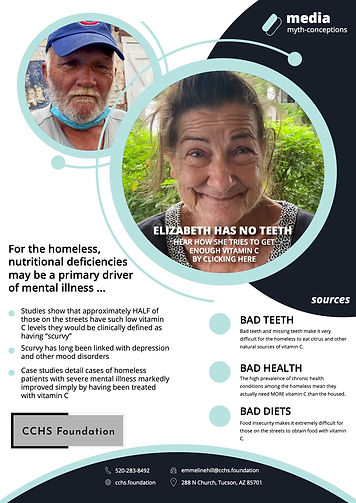
Due to lack of dietary Vitamin C, up to half of those on the streets may have hypovitaminosis C aka scurvy.

Poor nutrition makes the homeless more susceptible to illnesses like tuberculosis which spreads easily in shelters.

Being pregnant and living on these streets creates a high risk of premature birth and other adverse outcomes.

43.6% of those on the streets are deficient
in Vitamin A which can lead to night blindness.

For those on the streets with alcohol use disorder, malnutrition is a persistent and deadly worry.

More than 70% of the homeless reported at least one barrier to getting enough protein in their diet.
The homeless are constantly pushed to the margins

A recent study in JAMA points to a 25% increase in deaths from the practice of sweeping homeless encampments.

Due to lack of effective screening programs, the homeless have double the mortality from cancer.

Transgender women experience much higher rates of homelessness with associated poor medical outcomes.

Approximately 17% of homeless sex workers are between the ages of 55 and 74.

Pushed to the margins, many homeless live in dusty areas covered with Valley Fever spores.

Millions of children globally are now homeless due to being displaced by the effects of war.
Environmental exposures are hidden killers

Mosquito-borne viral illnesses like dengue are a risk to the homeless due to constant outdoor exposure.

People without shelter who are constantly exposed to heat are most at risk for the adverse effects of climate change.

Cooling centers for the homeless rarely take into account the true needs of those on the streets.

Pavement during the summer may be hot enough to cause serious third-degree burns to those on the streets.

In a recent CCHS Foundation study, fully three-quarters of the homeless surveyed had no tarp or rain cover of any kind.

For the homeless living near contaminated water, the risk of potentially deadly fecal bacterial infection is 88%.

Those on the streets have 2 to 4 times the risk of developing non-melanoma skin cancers.

Due to constant exposure to mosquitos, the homeless have a much higher risk of developing West Nile virus.

With tens of thousands of people currently living in their cars, carbon monoxide poisoning is a growing risk.

A homeless campfire using plastic as a fuel source is a possible source of deadly cyanide gas.

Due to the extreme heat, many medications used by the homeless may lose their potency and fail.
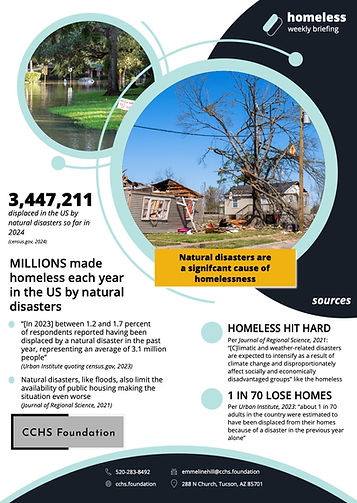
Millions of Americans are made homeless each year due to the effects of extreme weather.